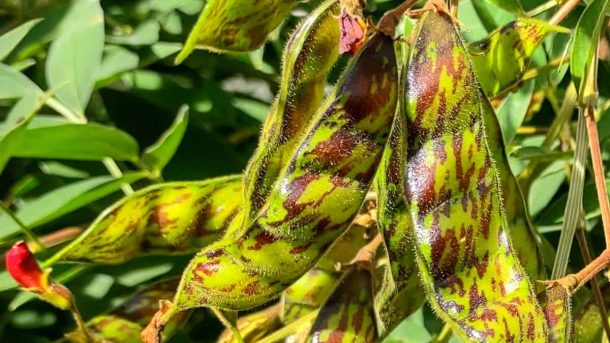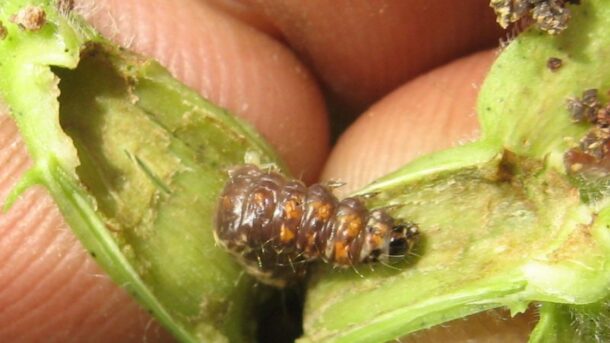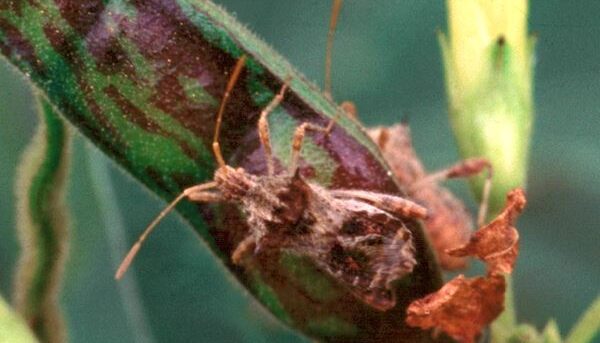
Do you know how pod bugs damage red gram (Tur dal)?

damage

Pod borer insects can cause damage to red gram crops. These pests lay their eggs in the pods of the plant and when the larvae hatch, they feed on the seeds, reducing both the yield and quality of the harvest.To control these pests, farmers can use a combination of cultural, biological, and chemical methods, such as crop rotation, using resistant varieties, and applying insecticides

Application of Spinosad or imidacloprid gives control upon pod bug damage. Spraying of quinalphos 25% EC @ is effective against pod fly and pod borer. Spraying of effective molecule like Indoxacarb 14.5 SC % @ 300 ml/ha or Emamectin benzoate 5% SG @ 11 a.i gm/ha or Spinosad 45 SC @ 56-73 a.i gm/ha is effective against Pod borer complex. 

However, it’s important to implement integrated pest management practices to minimize the negative impact on the environment and human health.
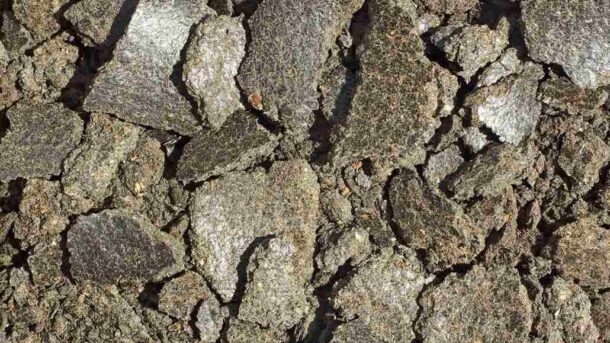
How do oil cakes help plants?

oilcakes

 Oil cakes can help plants in several ways:

Nutrient-dense fertilizer: Oilcakes are high in nitrogen, phosphorus, and potassium, all of which are essential plant nutrients. The use of oil cakes as a fertilizer can improve soil health and crop yield.

Soil improvement: By adding organic matter to the soil, oilcakes can improve soil structure and fertility. This can aid in reducing soil erosion, increasing water retention, and encouraging healthy root growth.

Pest control: Natural compounds in oilcakes can act as a repellent to pests, reducing the need for chemical pesticides.

Nitrogen-fixing bacteria: Nitrogen-fixing bacteria can be found in some oilcakes, such as soybean oilcake. These bacteria aid in the conversion of atmospheric nitrogen into a form that plants can use, thereby increasing soil nitrogen content.

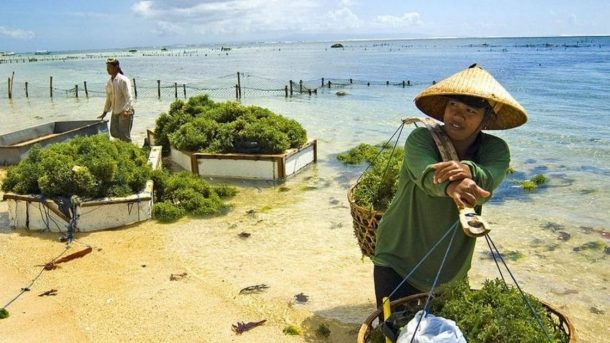
Seaweed- As Biomass for fuel

sea weed

Macroalgae, commonly referred to as seaweed, has the potential to be used as a source of biomass for the manufacture of fuel. It can be burned as a solid fuel to produce energy or processed into biofuels like bioethanol and biodiesel.

Fast growth rates, high biomass yields, and the capacity to grow in salty conditions are just a few of its many benefits as a biomass source. It also doesn’t compete with food crops for freshwater and land resources.

Seaweed farming also has the potential to reduce carbon dioxide emissions and enhance water quality. Seaweeds of the Laminaria, Gracilaria, and Sargassum species were among the types utilized to make biofuel.

In Macrocystis, the seaweed’s mannitol and alginate contents were key factors in the good gas output. If the concentration of mannitol was high, a high percentage of gas was created. In Gracilaria, the output of methane was strongly related to the amount of carbohydrates. Sargassum generated low gas.

Seaweed can be used to produce fuel, but there are drawbacks as well. For example, effective harvesting and processing techniques are required, and seaweed-based biofuels are more expensive to produce than conventional fossil fuels.

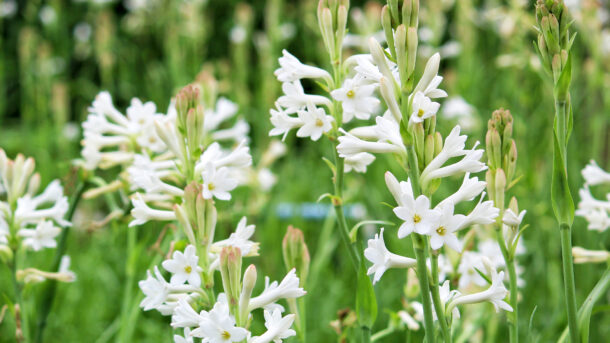
Management of Nutrient in tuberose.

tuberose

Tuberose reacts well to the application of organic and manures. Not only FYM (20 tonnes/ha) but also a fertilizer dose of 100 kg N, 50 kg P2O5 and 70 kg K2O per hectare is suggested for tuberose production.

Foliar spray of ZnSO4 0.5% + FeSO4 0.2% + Boric acid 0.1% improves growth and flowering. For achieving increased essential oil content in flowers and for the maximum recovery of concrete, a fertilizer dose of 80 kg N, 60 kg P2O5 and 40 kg K2O per hectare has been advised.

What are seed rate required for Lady’s Finger (Bhindi)?

Lady’s Finger

The precise seed rate will always vary depending on soil type, climate, and desired plant population in any crop. The seed rate required for Lady’s Finger (Bhindi) is approximately 4 to 5 kg of seeds per hectare

As per season, the seed rate is 3.5-5.5 kg seeds/ha during summer and 8-10 kg seeds/ha for rainy season crop. Before sowing the seeds are soaked in a solution of Bavistin (0.2%) for 6 hours. The seeds are then dried in shade.

Main Insect pest and their treatment in pigeon pea.

Rajendra Arhar

The main insect pests of pigeon pea and their treatments are: 

Pod borer (Maruca vitrata) and Leaf folder (Cnaphalocrocis medinalis): Chemical control with insecticides such as chlorantraniliprole, emamectin benzoate, or synthetic pyrethroids can be effective in controlling this pest and leaf folders.

Stem fly (Melanagromyza obtusa) and Shoot fly (Atherigona soccata): Crop rotation and the use of insecticides such as imidacloprid, lambda-cyhalothrin, and carbofuran can help manage this pest. 

Termites (Macrotermes spp.): Chemical control with insecticides such as chlorpyrifos or imidacloprid can be effective in controlling termites. Cultural practices such as crop residue removal and soil moisture maintenance can also aid in termite population reduction.

Aphids (Aphis craccivora): Aphids can be controlled by releasing natural enemies such as ladybirds and green lacewings, as well as using insecticides such as imidacloprid or acetamiprid

Thrips (Thrips palmi): The use of resistant varieties, the release of natural enemies such as predatory mites, and the application of insecticides such as spinosad or imidacloprid can all help control thrips.

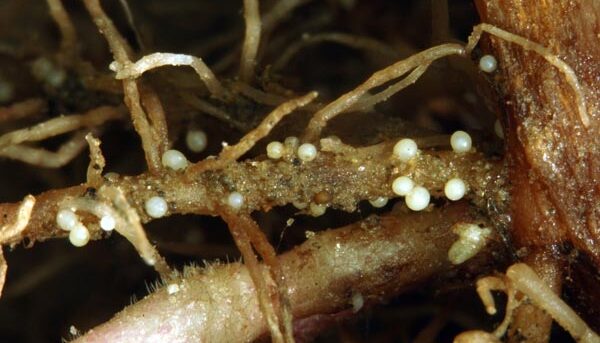
Nematode elimination in soil by Oilcakes.

Oilcakes

Oilcakes have been shown to have some effectiveness in eliminating nematodes in soil. Nematodes are parasitic worms that feed on plant roots and can cause significant damage to crops.

One of the ways that oilcakes can help eliminate nematodes is through the release of natural compounds such as allelopathic compounds, which are toxic to nematodes and other pests. These compounds are released from the oilcake when it is decomposed by soil microbes.

Another way that oilcakes can help eliminate nematodes is by promoting the growth of beneficial soil microbes, such as fungi, which can help reduce the populations of nematodes in the soil. The high organic matter content of oilcakes can also improve soil structure and fertility, which can help make the soil environment less favorable for nematode survival.

However, it is important to note that the effectiveness of oilcakes in eliminating nematodes can vary depending on the type of oilcake and the nematode species present in the soil.

In summary, oilcake have the potential to be a valuable tool in controlling nematodes in soil, but more research is needed to fully understand their effectiveness and to determine the best application methods.

What is the treatment of spotted bollworm in Lady’s finger (Bhendi) crop?

spotted bollworm

The larvae of the Spotted bollworm (Earias vittella) primarily attack the shoot. It causes terminal shoots to dry and drop during the pre-flowering stage, as well as holes in the fruit during the young fruiting stage.

Bioinsecticide sprays containing Bacillus thuringiensis are used to control the population peak of the spotted bollworm. Spraying with 5% Neem Seed Kernel Extracts (NSKE) or Neem Oil (15000pm) @ 5ml/l is also beneficial.

Insecticides containing chlorantraniliprole, emamectin, benzoate, flubendiamide, or esfenvalerate are primarily used during the egg stage. Before using any chemical treatment, it is essential to consult with a professional and follow the instructions on the pesticide label.

How Black Scurf disease cause damage to sweet potatoes?

Black Scurf disease

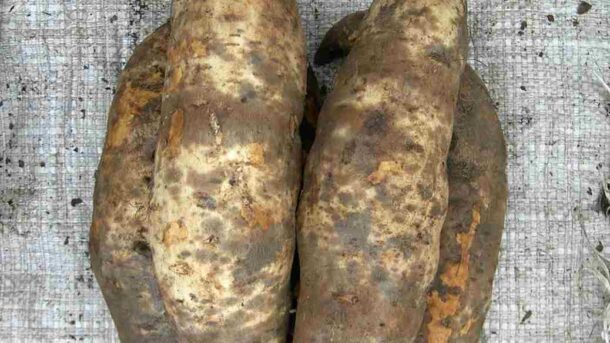
The soil borne fungus Monilochaetes infuscans causes Black Scurf disease in sweet potatoes, which can cause significant crop damage. The disease infects tubers and causes raised, dark-colored scabby lesions on the surface. 

This not only changes the appearance of the tubers, but also makes them more susceptible to secondary infections, which can reduce the crop’s quality and marketability even further. The fungus can also infect the plant’s stems and leaves, causing stunted growth and decreased yields.

What are oilcakes?

oilcakes

Oilcakes are a byproduct of oil extraction, which is the extraction of oil from seeds or nuts. The remaining solid matter is referred to as oilcake or meal. It is a high-protein source that is used as animal feed or as a fertilizer. Oilcakes, which are both edible and non-edible, are used as manure.

Mustard cakes, Neem Cakes, and Groundnut Cakes are excellent examples of oil cakes. Certain oil cakes made from poisonous seeds such as castor beans and tung nuts are used as fertilizers instead of animal feed.