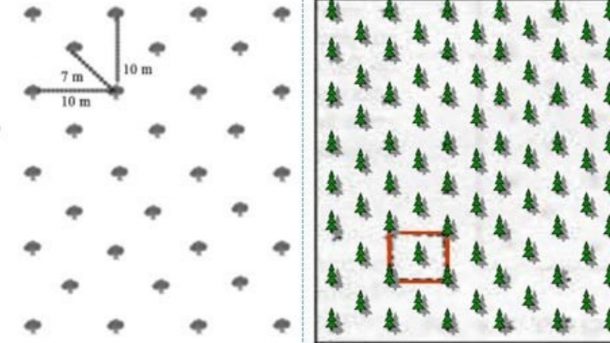
This is the square method but with one more plant in the centre of the square. This will accommodate double the number of plants, but does not provide equal spacing. The central filler tree chosen should be a short lived one and should be removed after a few years when main trees come to bearing. This system can be followed when the distance between the permanent trees is more than 10m.
Sustainable agriculture
How trees are planted in hexagonal system for orange cultivation?
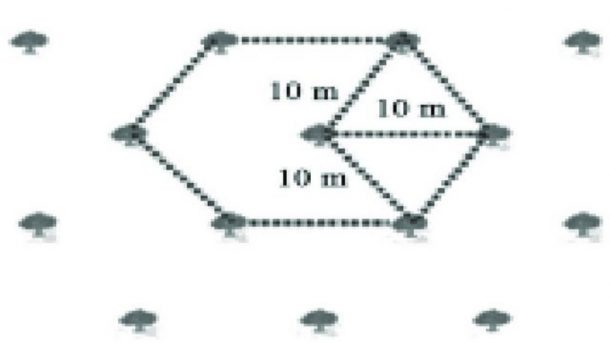
In this method, the trees are planted in each comer of an equilateral triangle. This way six trees form a hexagon with the seventh tree in the centre. Therefore, this system is also called as ‘septule’ as a seventh tree is accommodated in the centre of hexagon. This system is difficult to layout and for doing cultural operations. This system accommodates 15% more trees than the square system.
How trees are planted in rectangular system for orange cultivation?
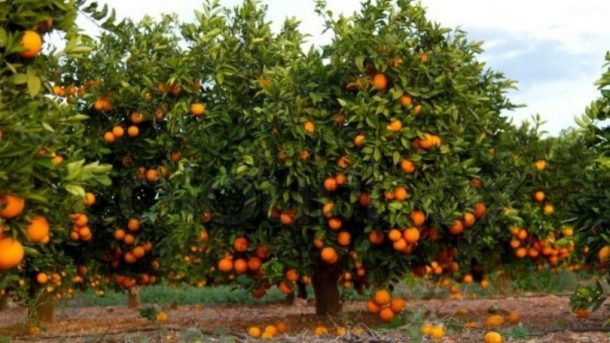
In this system, trees are planted on each corner of a rectangle. The distance between any two rows is more than the distance between any two trees in a row. The wider row spaces permit easy intercultural and mechanical operations.
How trees are planted in square system for orange cultivation?
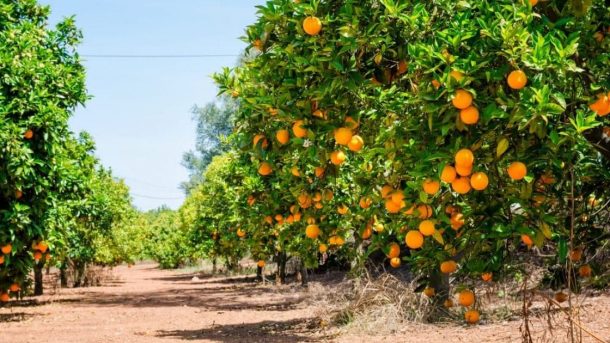
In this system, trees are planted on each comer of a square whatever may be the planting distance. This is the most commonly followed system, easy to layout and permits inter cropping and cultivation in two directions The central place between four trees may be advantageously used to raise short lived filler trees.
When and how birds cause damage in pomegranate crop?
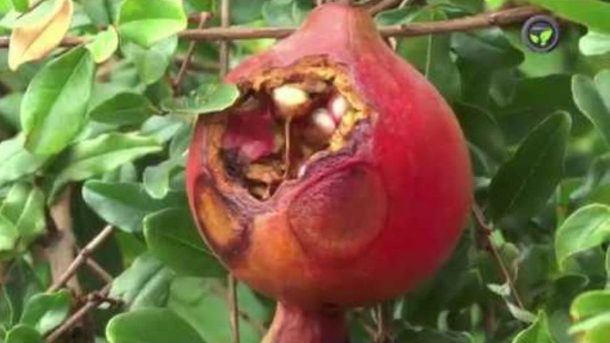
Birds particularly parrot and sparrow cause heavy losses to pomegranate fruits after 2-3 month of fruit set when aril start developing. The type of control method will depend on a number of factors like crop stage, damage patterns and species behaviour etc. For small orchard and isolated trees, netting with anti-bird net is the most effective way to reduce bird damage. In most cases, netting is spread directly over the plants through support by iron frame. It has a high initial cost, but effective in pomegranate due to high cost of produce. Bird scaring ribbon and noise makers also used to keep birds away from crops. Noise making devices such as cannons, exploders, sirens are also available. These devices work best when the sound is presented at irregular intervals and the sound source is moved frequently. Covering of fruit with bags is also found effective against bird damage.
Why aril browning occurs in pomegranate?
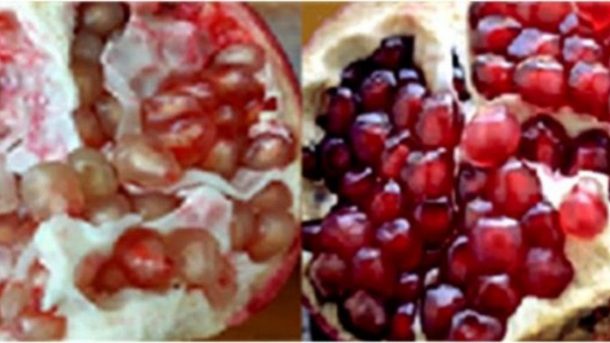
It is due to delayed harvesting in which arils become brown and start rotting. The harvesting should not be delayed beyond maturity period. The pomegranate fruits should be harvested as soon as they mature viz. between 140-150 days after blooming in Jalore Seedless and 170-180 days in Bhagwa.
Why sunscald occurs in Pomegranate?
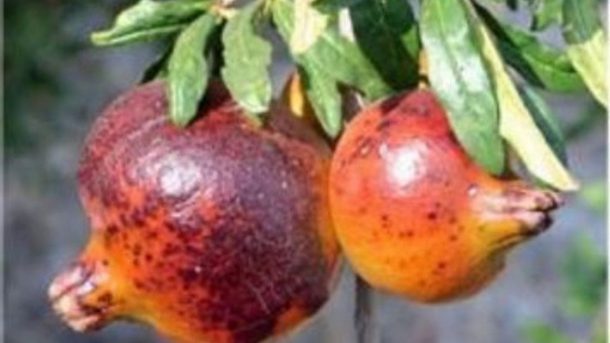
In hot arid region, sun scald is also serious disorder particularly in ambe bahar crop and improper canopy managed orchard. Surface of fruits which is towards sun light turns brownish black due to intensive scorching heat during hot months particularly during May to July. Proper canopy management is required to avoid the direct exposure of fruits to sunlight. Kaolin 5% spray during May to July months is useful in reducing the sunscald. Shading with 35% shade net is helpful in reducing sunburn on pomegranate fruit. Bagging of fruits with cover bags is also useful in minimizing sun sunscald problem. White colour bags are more efficient in reflecting sunlight.
Why fruit cracking occurs in Pomegranate?
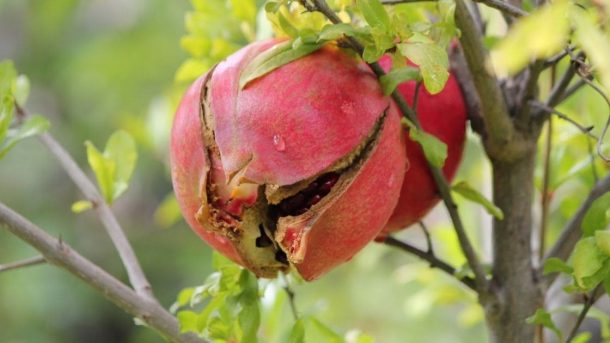
It is major problem in pomegranate under arid and semi-arid regions and about 25-60% fruit cracking has been reported during maturity in different bazar. It also varies with variety, season and climate. The cracked fruits are sweeter with low keeping quality; highly liable to fruit rot and are unfit for transport. In fruit cracking, xylem and phloem tissue loss their ability to divide and enlarge. In summer, after dry spell (April-June) water supply is increased and meristematic tissue quickly resume growth but due to uneven growth rate fruit splitting occurs. while during winter fluctuating moisture and temperature causes cracking. Dry hot wind at the time of fruit ripening is the main cause of cracking during ambe bahar, rapid aril growth, temperature higher than 38°C combined with less than 60% humidity favoured cracking. Nutrients like boron, calcium, copper, zinc, molybdenum, manganese and potash are involved in different physiological activities during fruit growth and development. Deficiencies of nutrients along with imbalanced use of nutrients also cause cracking. In young orchard, fruit cracking is due boron deficiency while in old orchard moisture imbalance and fluctuating temperature are major factor associated with fruit cracking. Fruits split generally when rains come or irrigation is given after a long dry spell. For cracking management apply adequate and regular irrigation during fruiting season. Spray of gibberellic acid @ 20 ppm, calcium chloride 2% and boron 0.2% at fruit enlargement and 1 month before harvest can help in reduce cracking. Cover fruits with bags in hot dry period and maintain sufficient calcium and potassium levels as per soil test report.
Why male buds are removed in banana?
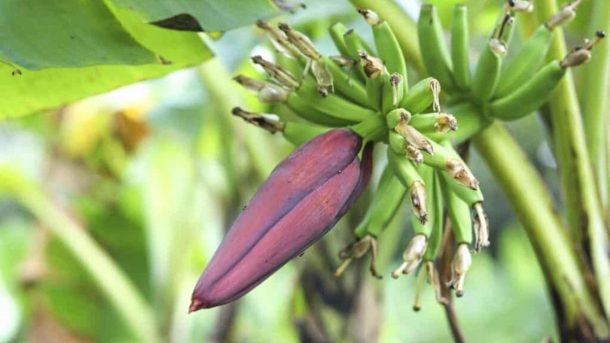
The male bud or navel should be removed after bunch formation is complete. The advantages of removing the male bud include increase in yield, faster maturing of bunches and reduced thrips attack.
Why trimming of old leaves is done in banana?
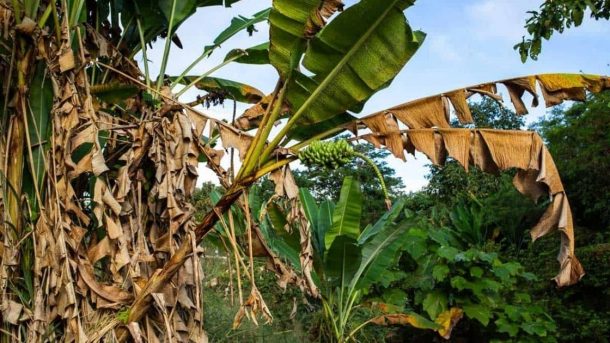
This activity is useful since it ensures light penetration in the orchard and helps reduce certain leaf diseases and reduces injury caused to banana by the dry leaves during windy periods. All dry/dead leaves which hang down the sides of the pseudo-stem need to be removed at least twice a year.